



Television journalists are facing daily obstacles in covering court proceedings. Although there is a specific Guideline adopted by the High Judicial Council regulating relations with the media, particularly regarding the presence of television cameras in court hearings, this document is being used primarily as a restrictive mechanism and, in many cases, is being openly violated.
This phenomenon is becoming even more concerning at a time when important criminal proceedings involving high-profile political figures have begun before the Special Court Against Corruption and Organized Crime (SPAK/GJKKO), generating exceptionally high public interest.
Under these circumstances, several of the country’s leading television broadcasters have addressed the High Judicial Council (with copies sent to courts of all levels, as well as to the Council of Europe and the OSCE Representative on Freedom of the Media) requesting immediate intervention to safeguard the right to information, a principle enshrined in the Constitution of Albania.

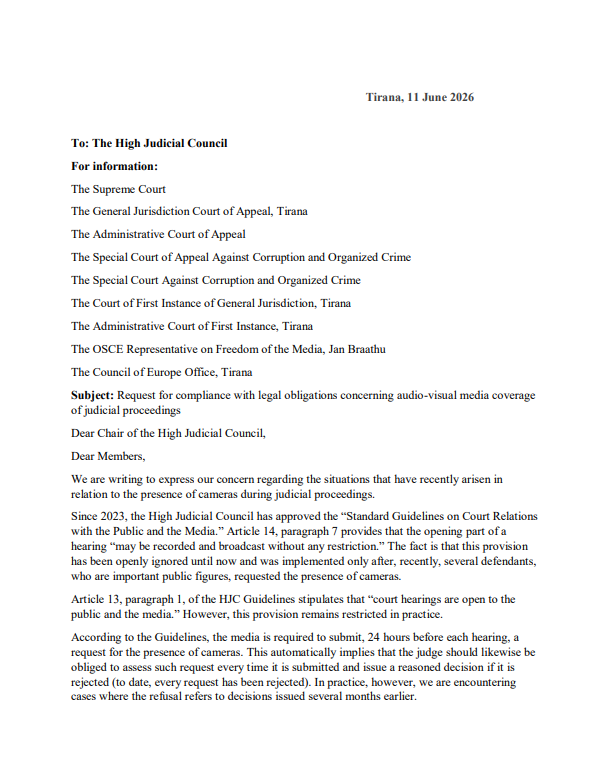
Below is the full text of the letter sent to the High Judicial Council
To: The High Judicial Council
For information:
The Supreme Court
The General Jurisdiction Court of Appeal, Tirana
The Administrative Court of Appeal
The Special Court of Appeal Against Corruption and Organized Crime
The Special Court Against Corruption and Organized Crime
The Court of First Instance of General Jurisdiction, Tirana
The Administrative Court of First Instance, Tirana
The OSCE Representative on Freedom of the Media, Jan Braathu
The Council of Europe Office, Tirana
Subject: Request for compliance with legal obligations concerning audio-visual media coverage of judicial proceedings
Dear Chair of the High Judicial Council,
Dear Members,
We are writing to express our concern regarding the situations that have recently arisen in relation to the presence of cameras during judicial proceedings.
Since 2023, the High Judicial Council has approved the “Standard Guidelines on Court Relations with the Public and the Media.” Article 14, paragraph 7 provides that the opening part of a hearing “may be recorded and broadcast without any restriction.” The fact is that this provision has been openly ignored until now and was implemented only after, recently, several defendants, who are important public figures, requested the presence of cameras.
Article 13, paragraph 1, of the HJC Guidelines stipulates that “court hearings are open to the public and the media.” However, this provision remains restricted in practice.
According to the Guidelines, the media is required to submit, 24 hours before each hearing, a request for the presence of cameras. This automatically implies that the judge should likewise be obliged to assess such request every time it is submitted and issue a reasoned decision if it is rejected (to date, every request has been rejected). In practice, however, we are encountering cases where the refusal refers to decisions issued several months earlier.
Article 2, paragraph 1, of your Guidelines provides that “the relationship of the court with the public and the media is based on the principles of equal access to courts, the public nature of judicial proceedings, the maximum openness of judicial activity towards society through communication with the public, the right to information, the protection of human dignity, privacy and personal data, reputation, as well as the presumption of innocence.”
In balancing these principles, it is evident that the right to information, enshrined in the Constitution, appears to be ranked last by judicial panels, without any effort to find an appropriate balance with the other principles. In practice, we are witnessing references to the alleged infringement of other principles being used to obstruct the right to information.
Your provision in Article 14, paragraph 8/b, allowing the rejection of a request “when one of the parties to the proceedings does not wish the hearing to be recorded,” is being widely used as grounds for denying the presence of cameras, although the same article, in paragraph 6/b, grants the judge the authority “to allow or prohibit the partial recording of a hearing,” meaning that this authority could be exercised when it is the turn of the defendant who does not wish to be recorded to testify, rather than prohibiting the recording of the entire hearing. Does this not constitute an infringement of the rights of the other parties to the proceedings who request that the hearing be recorded?
Moreover, Article 14, paragraph 8/b, expressly provides that lawyers and prosecutors may not object to requests for the recording of a hearing. Nevertheless, we have witnessed cases in which they have expressed opposition during the hearing.
Dear Members of the High Judicial Council,
Public judicial hearings cannot be understood as referring only to the audience physically present in the courtroom. Otherwise, this concept would automatically be limited, if only because of the physical constraints of the environment in which the proceedings take place. The media serves precisely to ensure that this concept extends to the wider interested public.
The role of the media becomes even more important given that none of the Albanian courts offers a centralized audiovisual broadcasting system. Even audio recordings, surprisingly, are made available only to the parties involved in the proceedings, while journalists are not allowed to make such recordings themselves in the courtroom. This is a minimal request that would only strengthen the guarantees of accurate reporting of statements made by the parties during judicial proceedings. Audio recording of court hearings through tape recorders, which every journalist traditionally carried with them, was a practice applied for many years by all Albanian journalists, but which, surprisingly, has now been prohibited together with video recordings.
The right to information and public hearings, as provided in principle by the HJC Guidelines, represent a rule. Unfortunately, experience to date shows that they are being treated in a reversed manner, as an “exception to the rule.”
Among the obstacles that burden journalists every day in covering court proceedings, we must also include the prohibition on studying court files, which are now available in digital form as well. Unlike what happens in European countries, journalists do not have the right even to read the files of cases that are publicly heard during court proceedings. The only “documents” available to journalists today are those selectively provided by one of the parties to the proceedings.
In this situation, we request the prompt intervention of the High Judicial Council in order to find a solution that does not undermine the right to information. The HJC may provide a more detailed interpretation that would allow the media to carry out its mission without obstacles, while narrowing the discretionary space for rejecting requests to follow judicial proceedings and enabling reporting to public opinion with maximum accuracy, as can only be guaranteed through audio and video recordings.
Signed by: Top Channel, TV KLAN, Vizion Plus, Report TV, News24, A2 CNN, Klan News
Kliko këtu për të lexuar letrën e plotë
Komente


Lajme të tjera
-
FOTOT/ Brenda kështjellës 2.6 mln euro të Ermal Beqirit në Francë, ja si duket rezidenca luksoze që SPAK kërkon t'ia sekuestrojë
2 Gusht, 15:37 -
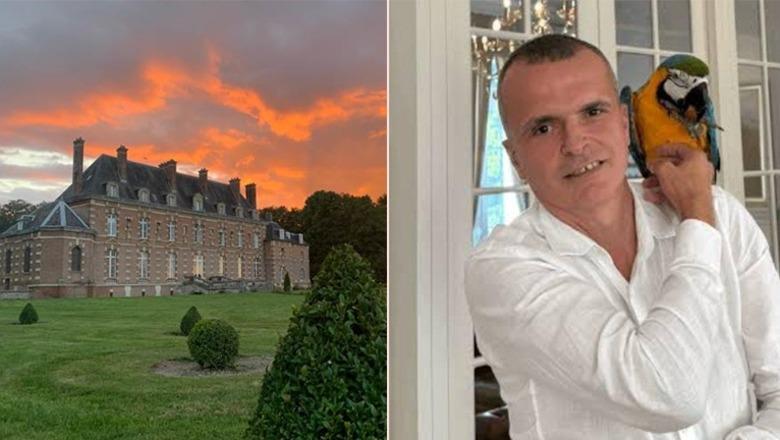
Ermal Beqiri me kështjellë 2.6 mln euro në Francë, ja VIDEO si duket! Llogari 2 mln euro, apartamente e mjete motorike! SPAK kërkon sekuestron e pasurive
1 Gusht, 16:12 -
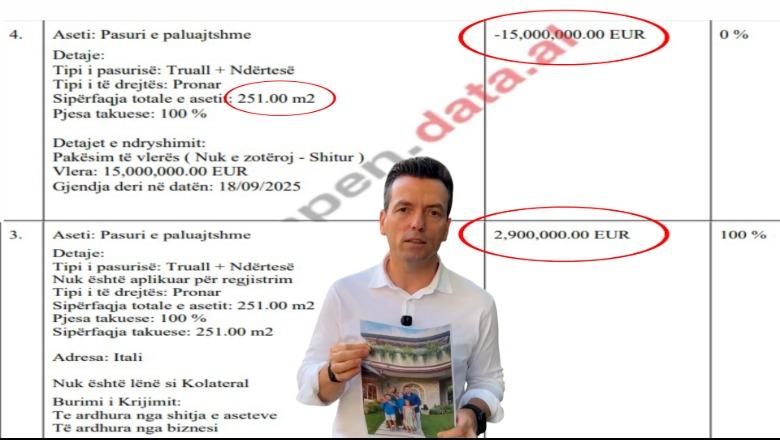
Vila 15 mln euro në Itali, Agron Shehaj kallëzohet në SPAK! Nuk deklaroi 4 mln € investim, as ndryshimin e sipërfaqes. Formalizoi miliona euro të tjera pa faktuar origjinën
31 Korrik, 17:07 -
110 mln euro të Artur Shehut të sekuestruara, avokati Cakrani: Vendimi do të ankimohet! Toka që iu shit sirianëve ka certifikatë trashëgimie
31 Korrik, 15:03 -
Abuzimi me fondet e SASPAC/ Ilir Beqaj lirohet nga qelia, GJKKO i cakton masën arrest në shtëpi! I përfunduan afatet e paraburgimit (VIDEO)
31 Korrik, 11:49 -
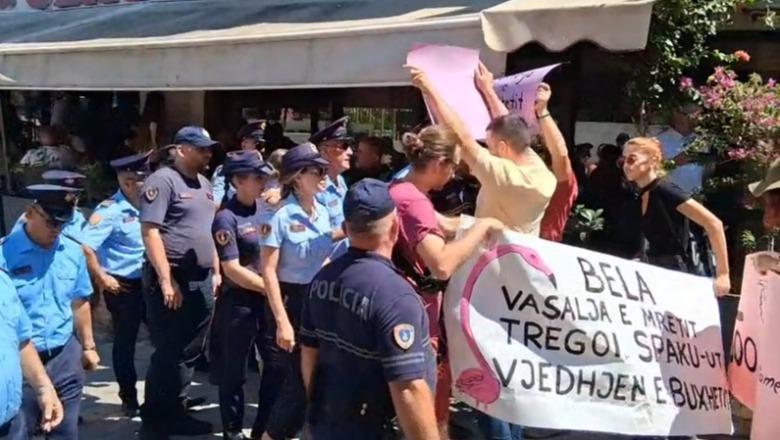
‘Bela-ja e pushtetit’, Ballukut pritet t’i komunikohet akuza për shkeljen në 6 tendera të tjerë, protestuesit grumbullohen para SPAK (VIDEO)
31 Korrik, 11:34 -
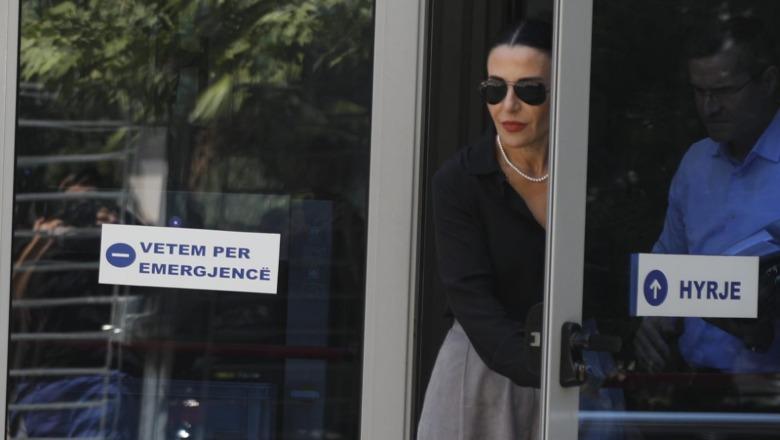
EKSKLUZIVE/ Paracaktoi fatin e 8 tenderëve, SPAK merr të pandehur Belinda Ballukun edhe për 6 lotet e Unazës së Madhe! I komunikohet akuza (VIDEO)
31 Korrik, 09:47
-
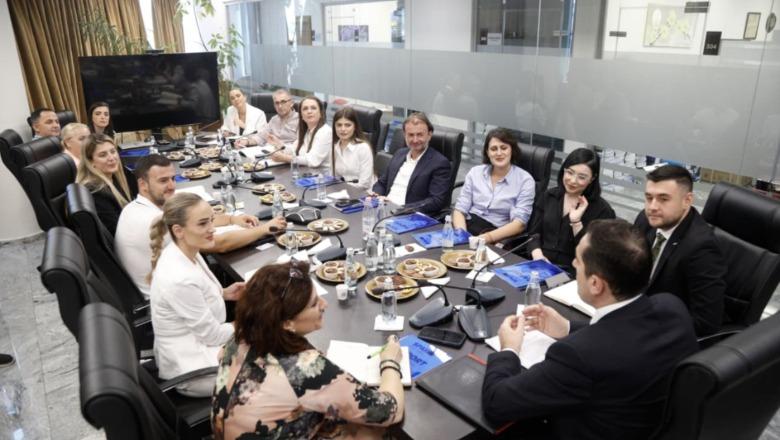
Braho bën bilancin në krye të SPAK, 440 mln € pasuri të sekuestruara, në 7 muaj dyfishi i 6 viteve: Goditëm 7 grupe kriminale, hetim 16 zyrtarëve
30 Korrik, 17:16
-
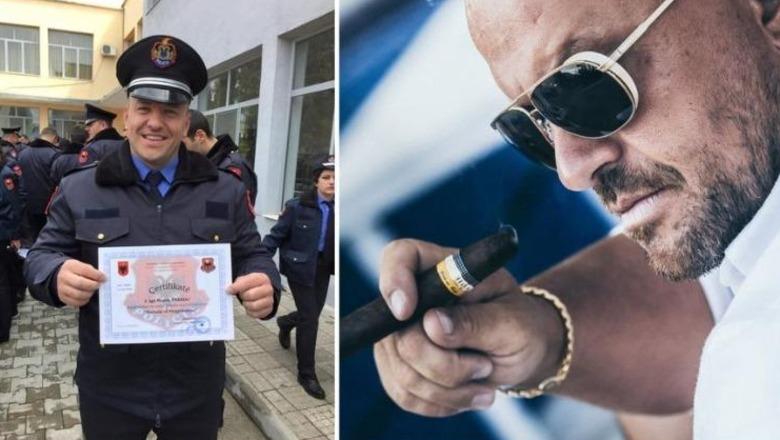
Pjesë e grupit të Visit të Pojës, GJKKO dënon me 2 vite e 8 muaj burg efektivin Igli Haxhiaj! I ndalohet për 5 vite ushtrimi i funksioneve publike
30 Korrik, 15:44 -
Dosja SASPAC/ Ermal Kurtulaj del nga qelia, GJKKO e lë nën arrest shtëpie
30 Korrik, 15:37 -
SPAK: Ermal Beqiri u lokalizua prej javësh në Francë, për pasuritë atje është kërkuar sekuestro! Report Tv i zbulon kompaninë IT, ‘Al Soft’ në shtetin francez
30 Korrik, 15:09
-
Vodhi dokumentin sekret me SHBA, Agron Shehaj kallëzohet në SPAK! Braho: Po verifikohet
30 Korrik, 13:12